
New Math


I want to talk about music. I want to talk about how music comes to define its time and how in this time, now, the soul of it is being ripped out from underneath us. And to do that I want to talk about nuclear weapons first.
It’s 1945, and we are all going to die
The immediate postwar era is a fascinating time in cultural history. It was a time of staggering prosperity in the United States, but there was a naked terror lying in wait, underneath everything.
In the immediate aftermath of the Second World War, The Hollywood Reporter began publishing the names of directors and actors they thought had Communist sympathies, which eventually led to an official Hollywood blacklist. There were anti-communist films like My Son John, about a quintessentially American family with a dark, red secret, and The Red Menace.
The Red Menace was released on August 1st, 1949. On August 29th, the Soviet Union completed its first nuclear weapons test in what is now Kazakhstan.

The V-2 ballistic missile was the precursor to the intercontinental ballistic missile, or ICBM. First developed during the Second World War by German engineer Wernher von Braun, the rockets could be fired at a range of up to about 130 miles, and the Nazis used them to hit Antwerp, Liege, and London. In 1944, it was the first man-made object to make it to space.
In 1945, the Nazis lose. As the Red Army placed its flag on the Reichstag, the Allies were flooding into Germany from the West. They found the true extent of the horrors of the Holocaust, along with the remains of the German cities they’d been firebombing since the start of the year.
In the case of the Americans, they also found a wealth of scientific and engineering talent. Very suddenly, these Nazi nerds were out of a job. The operation codenamed Paperclip duly repatriated over 1,500 Germans to the United States, one of whom was Wernher von Braun.
Once East met West in the middle of Berlin, the Cold War started, and the bombings in Hiroshima and Nagasaki were a signal of intent from the US. This is the power we’re capable of. Don’t force us to use it.
But if the US wanted nuclear missiles that could strike targets in the Soviet Union, the range of the V-2 wasn’t going to cut it, unless they wanted to bother some bears in very, very Eastern Russia. So, von Braun lent his skillset to the US Army, helping them develop an intermediate-range ballistic missile, which had a range over 10 times that of the V-2.
Which meant it would soon be possible to hit basically any Russian city you wanted. Now that’s more like it.
The United States in the Cold War era was full of contradictions. Criticising the regressiveness of the Soviet Union while maintaining racial segregation, criticising Stalin’s authoritarianism while putting together a cultural blacklist, proselytising Western capitalism and ideology while working with former Nazis to get you to the moon.
Somebody noticed.
Tom Lehrer was a mathematician, musical satirist and the inventor of the Jell-O Shot. He graduated his bachelor’s in mathematics from Harvard aged 18, and was a teacher before using his innate skill on the piano to release a repertoire of caustic takedowns of contemporary American society.
There’s one about what was then a revolution in mathematics teaching known as the “New Math”. He fit every chemical element into a single song set to the tune of Gilbert & Sullivan’s “Major-General’s Song,” a feat probably made most famous by Daniel Radcliffe’s rendition on The Graham Norton Show.
On the subject of nuclear armageddon, Lehrer wrote “We All Go Together When We Go,” a touching rag about how the human race will never be closer together than when we’re all being vaporised at once. “So Long, Mom” puts you in the shoes of the trooper dropping the first bomb of the planet’s final war, and “Wernher von Braun…”
Don’t say that he’s hypocritical
Say rather that he’s apolitical
“Once the rockets are up, who cares where they come down?
That’s not my department!” says Wernher von Braun…
His was a withering, Ivy League-educated wit. He wasn’t making angry, polemical music – less Scott-Heron and Dylan, more Danny Kaye. His audiences weren’t the shabbily-dressed masses of Woodstock – he played in a suit to crowds of other suits in Copenhagen and Cambridge, MA, the home of MIT.
I’m not the kind of person that thinks satire will save the world. For too many well-meaning but ultimately dim, middle-class liberals, giving Donald Trump a funny nickname is given more importance than credibly pointing out that he is resurrecting the Gestapo. It’s the attitude that means the modern Democratic Party seems more concerned with social media clapbacks than with actually doing their jobs.
But Lehrer’s pen was no less acidic because of his liberalism or his privilege. “National Brotherhood Week” skewered a national American holiday that encouraged harmony with your fellow man, in a country which at that time was still under the Jim Crow laws. Lehrer reached the peak of his career as the ‘60s began, a time when his country’s divisions and hypocrisies have never been more ripe for satire.
The decade had barely begun when Lehrer made a decision that I’m surprised more artists don’t – he quit. The idea of repeating his songs ad nauseam on tour for years on end simply didn’t appeal to him, and you could argue many bands should have followed his example. In any case, across the years Lehrer’s songs endured, and they would eventually find airtime over two decades after they were recorded on the Dr Demento Show, and receive even more exposure on the nascent internet, inspiring the first wave of properly online musicians.
I first started writing about Tom over a year ago, when I took an annual rifle through his best songs. Then, in July of this year, he very rudely died before I could finish anything, at the age of 97. I suspect he would not mind me saying this.
A few years before his death, Tom released all of his music into the public domain.
Actually, in his words,
“The music written or composed by me [has] been permanently and irrevocably relinquished [into the public domain.]
In particular, permission is hereby granted to anyone to set any of these lyrics to their own music, or to set any of this music to their own lyrics, and to publish or perform their parodies or distortions of these songs without payment or fear of legal action.”
That word “distortion” is probably going to end up being important.
What this essentially means is that as long as you have access to Lehrer’s catalogue - the files are easily accessible online, if you know where to look - you could put together your own compilation of his music, or record covers without worrying about drawing the ire of a record label. Or you could do something much worse.
They Think They’re Playing in a Band
On streaming services, the artist pages of many musicians who began releasing music in the middle of the 20th century is, in three words, a fucking mess. With the exception of the very biggest bands, whose estates keep an iron grip over which titles take pride of place, smaller artists’ pages will be full of unofficial compilation albums, with terrible album art and even worse metadata.
Lehrer was no exception. Last year, when I tried to navigate his page for the official releases, I saw a recommended artist beneath the albums called “The Lehrer’s Band.” Just reading the song titles, it was an exciting prospect. Lehrer’s songs weren’t all recorded – for some, only the lyrics survive. Had someone attempted to resurrect the lost songs, give them new life? Then I saw the album art.
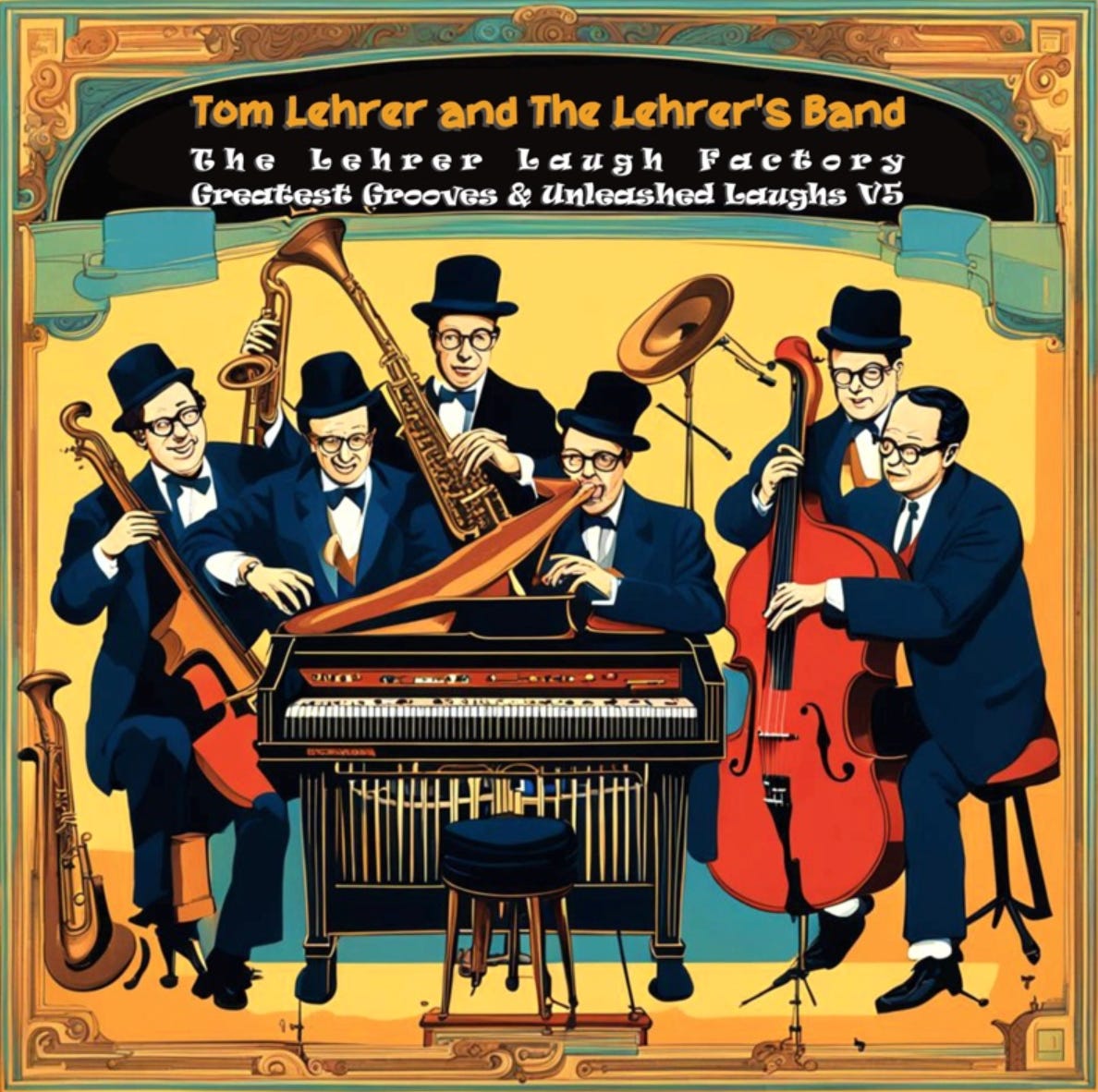
The Lehrer’s Band does not exist. The “creator” behind the band has “made” “albums” that alternate between original Lehrers and AI-generated ones based on the lyrics of the unrecorded songs. The result is a mess, where just as you get used to hearing a Lehrer classic you’re transported to some uncanny realm, some cabaret club where all the musicians are drunk and have never met each other before.
There is also a “tribute album” that “covers” - are the quotation marks getting annoying? There will be more. I’m sorry - the tracks that actually were recorded. Because the AI program can’t take into account changes in Lehrer’s register or the time signature, almost every “cover” sounds exactly the same, with the run-on lyrics and more oblique rhymes squashed together so the comic timing of the originals are lost. It is barely music.
However. For a moment I want to try and give the person behind this the benefit of the doubt. The person who “created” The Lehrer’s Band must have at least some knowledge of the man himself, to combine the classics with this new, AI-assisted spin on the unreleased songbook. Who was the bandleader?
From what I can gather, The Lehrer’s Band is a creation of a company called Digital World Contents S.A.S. based in Bogotá, Colombia. On its Instagram page, the company says it “distributes and monetizes digital entertainment content, from music and books to innovative ideas.” Which, okay. That is an AI-generated sentence, as are all of their Instagram captions, but let’s try and continue in good faith.
Most of the links provided don’t lead anywhere. The ones that do reveal the sole employee of Digital World Contents S.A.S. is Jovanhy Andres Ibañez Castillo, who also makes AI-generated music in the style of Daft Punk, and of Colombian cumbia. Apart from the music, I can find little else online about him.
Now, asking AI to make another “Get Lucky” I can understand. Lehrer, though, was harder to explain. The online following of The Lehrer’s Band is low, as are their views on YouTube. Even with all the corner-cutting that AI facilitates, it seems like a lot of work for not much benefit. Could it be that, through this new technology, Castillo was paying tribute to a musical hero in his own way?
So I asked him.

YouTube comments on every Lehrer’s Band video, including the ones of actual Lehrer songs, are also turned off. This is not the behaviour of someone convinced that they are doing something artistically worthwhile.
My suspicion is that Lehrer was an easy target. Perhaps the good people at Digital World Contents S.A.S. ran an AI search for artists whose music is in the public domain, and discovered that plagiarising Lehrer’s music would be the perfect heist. Because the lyrics are free of copyright, adapting and releasing them on streaming problems would provide no issue. Lehrer himself had made this possible.
The funniest part of this story is that in 1953, Lehrer wrote a song called “Lobachevsky” about the Russian mathematician, Nikolai Lobachevsky. In the song, Lehrer imagines that his subject’s work had a different origin:
I am never forget the day I first meet the great Lobachevsky.
In one word he told me secret of success in mathematics:
Plagiarize!
Let no one else’s work evade your eyes!
Remember why the good Lord made your eyes,
So don’t shade your eyes,
But plagiarize, plagiarize, plagiarize ---
Only be sure always to call it please “research”.
The real Lobachevsky was not, in point of fact, a plagiarist. Lehrer chose him because his name matched that of Stanislavsky, the subject of Danny Kaye’s earlier song that Lehrer’s is based on. The irony of using another person’s idea as “research” to create something new was certainly not lost on Lehrer.
The Lehrer’s Band’s version of “Lobachevsky”makes no distinction between the bits in the song that are spoken in a comedy Russian accent, and the ones that are sung in a comedy Russian accent. The result is a comedy song about plagiarism that has itself been plagiarised, made by an AI program that relies on plagiarism to operate.
If Tom Lehrer helped to define an era of uncertainty with impeccable comic timing, The Lehrer’s Band defines this era by stripping his music of that timing, by placing itself alongside that work and acting as though it’s equivalent. By skipping the decades of craft and hard work required to play the piano and crack jokes at the same time.
This AI-generated slop is just the rock pool that happened to cross over into my sphere of musical interest. But the oceans are rising. It’s getting bigger. Maybe even too big to fail.
Each day on twitter there is one main character. The goal is to never be it.
It’s 2025, and we are all going to die
Rosie Nguyen had it all. As jasminericegirl on Twitter, she posted funny, sexually frank missives, and defied the expectations society placed on her race, gender and economic status to become a Forbes 30 under 30 alum in the tech sector. Uh oh.
The username was misleading – her real passion was soup. Gorgeous, full soups of Thai basil, pork belly, coriander, sweet potato, if it tastes good in broth it’s going in the bowl. Eventually she started selling merchandise labelling the wearer a “SOUP-POWERED FUCK MACHINE.” There but for the grace of God go I.
You are Soup Girl. You are funny, beautiful and successful enough to have accrued a quarter of a million followers. As a poster, it does not get any safer than this. All that you have to do is not post anything that might shatter the image you have spent years assembling. How hard could that be?
I grew up singing. I sang everywhere I went, I wrote songs in my diary, I told teachers that I wanted to be a singer & songwriter when I grew up.
But wanting to be a musician in 2006 required resources that a low-income family didn’t have. My parents couldn’t afford to get me any instruments. They couldn’t pay for music lessons. They couldn’t get me into studios. A dream I had became just a memory, until now.
I am beyond proud and honored to get to work at a company that is enabling music creation for everyone. For the 13 year old kid in their bedroom who dreams of being a musician, you can be one. For all of the professional artists, you can do more of what you love.
I really wish Suno existed 20 years ago when I was a kid in elementary school, showing strangers songs I wrote with no way to produce them. But I’m really, really happy that it exists today, for all of the other kids who might need it.
We are still just getting started :)
Uh oh.
Suno is an AI-generated music platform that is about to receive over $250 million of additional funding, based on a valuation of over $2 billion. “Make a jazz song about watering my plants,” its website suggests to users. “Make a country song about Jess being late".
On the day I am writing this, Suno settled a copyright infringement lawsuit with Warner Music, the third-largest record label in the world. The two above them, Sony Music and Universal, remain in litigation.
Suno’s “songs” (sorry) are, at least, slightly more pleasant than The Lehrer’s Band, probably because a lot more money and computing power is being dedicated to their creation.
As Twitter’s main character on the day the above story was posted, the hypocrisies and inconsistencies of Nguyen’s praise for Suno have already been pointed out at length. Justin Bieber going from busking on street corners to the world’s biggest pop star in the blink of an eye is just one of the examples given that economic instability is not always a barrier to musical success. No one denies that money gives you a significant - often unearned - path to success, but the idea that this is the only way to succeed in music is laughable.
Ways to make music more accessible to young people such as expanding funding for it in schools, making music venues cheaper and more accessible, lobbying streaming service to increase their payouts to artists, none of it is worth doing for tech-brained people like Nguyen. Why waste time doing any of that when a prompt will do? Why devote yourself to a creative life, when you can outsource that part of your brain and devote the remaining time and energy to increasing shareholder value?
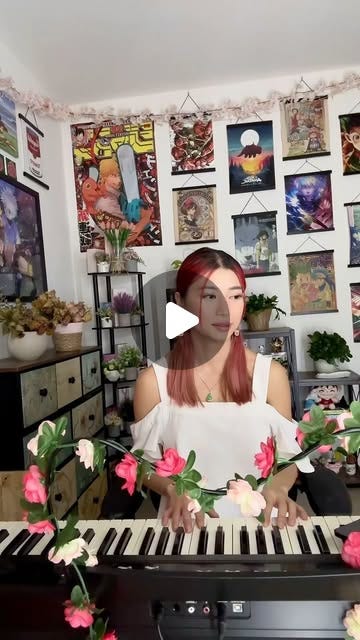
Perhaps the saddest revelation was a video of Nguyen sitting at a piano in late 2023, covering a song from Adventure Time. At the end of the caption, she says: “This song makes me happy and singing makes me happy, and I think that should be enough.” Apparently, it isn’t any more.
Maybe the reason I hate AI so much is because technology is the reason I never expressed myself creatively growing up. I spent my teenage years on forums, wasting unconscionable amounts of time that could have been spent learning something creative or at least useful. Why should people get to use technology now to “create” things without having to put any actual work or talent into it?
But on the other hand, because I never took the time to become an artist, what right do I have to criticise other people for using different tools to achieve it? For thinking that AI is not just an easy solution, but the thing that will unlock so many more creative minds?
This isn’t an article about my personal failures (you can read the previous two, for that). It’s not about seeing a personal hero being forced through the wood chipper of content, like just another brainrot mascot. Any personal bitterness I may have at not being the next Tom Lehrer is superseded by ecological and moral concerns that I want to leave you with, because
It’s Got To Go
The crux of my belief is this – generative AI has to go. If not immediately, then as soon as possible. There is no point waiting for the global financial bubble generated by the technology to explode, no sense in negotiating with the legions of blinkered fanatics claiming it’s the future.
If it is possible to sabotage its operation, to make it less effective or to break it without contributing to its environmental impact, it is the civic duty of literally everyone to do so, because if we don’t it is going to kill us. If that seems hyperbolic given I have so far been talking solely about music generation, consider the young man who killed himself after using an AI chatbot based on Daenerys Targaryen. Consider the woman who asked ChatGPT how to deal with her depression, and was given a method by which to commit suicide. The man who stopped eating salt because the same LLM told him to. The addict who was told by ChatGPT to just, you know, have a little meth.
The problem is that it’s already here, and here in a big way. Huge companies and regular members of the public now rely on generative AI to get through the day. Anything and everything is being filtered through Large Language Models, and when that technology is no longer available - something that I think has to happen - we’re going to need a societal initiative as large as the Covid-19 vaccine program to wean people off AI. The world’s largest digital detox.
When I’ve been writing about my personal issues in recent months, I’ve been spending that time looking inward. I’m also terrified of what’s happening outside of my brain, and I have no idea how to start doing what’s necessary to stop myself from just surrendering to the Soup Girls of this world, having to deal with the idea that genuine art, the thing that makes life worth living, will be sacrificed at the altar of prompts. The truth is that I am very scared, and I have no idea what to do, who to ask.
Well, alright. I know who - or rather, what - I’m not going to ask first.