
In the Devil's Territory
Wasn't going to call it "I Want To Be Well" was I. Be serious


For someone with no natural aptitude for mathematics, I love stats. Hours I’ve wasted, comparing the appearances and goal-scoring statistics on footballer’s Wikipedia pages, a habit that I took with me to a football-themed job which I promptly lost earlier this year. Who would have thought knowing who won the EFL Trophy two years in a row does not a career make. It was Peterborough United.
One of the few places left largely unaffected by the increasing slop-ification of online music services is last.fm, a platform that allows users to hook their account up to Apple Music, Spotify and a dozen other platforms to keep track of their listening habits through in-depth, track-by-track statistics, a process they’ve called “scrobbling”. You’d think after a few decades in business they’d have found a better name for it, but I’m not sure I have a better one so “scrobbling” it is.
Because the tracking started when I was 16, the artists with the highest play counts are, frankly, embarrassing in my 30th year. When I began writing this my #1 artist, despite nearly a decade of effort to shift him from the top spot was Jonathan Coulton, perhaps best known for writing “Still Alive,” the song that plays at the end of Portal.
Coulton was hired by Valve to write the song off the back of a career spent making whimsical, geeky songs in the pre-Reddit era. He has one about a supervillain taking over the world to spite their middle-school crush. He has a song about a zombie apocalypse in the style of a politely-written office email.
Perhaps as a preface to my development into a full-time snob, my favourites of his were always the ones that showcased his talent as a musician and storyteller, rather than the ones about video games and mythical beasts. I suppose I thought of myself as a truly refined 16-year old that was above that sort of stuff. There’s the lovely, folk-inflected cover of the Beatles’ “I Will,” or the all-out rock of “Sticking It to Myself,” my most-played song of all time, driven by the production of They Might be Giants’ John Flansburgh.
Elsewhere in my top ten are both incarnations of Ben Folds’ professional career. Combining Ben Folds and Ben Folds Five would make him my most-played artist by nearly 3000 plays. Folds once described his band as “punk rock for sissies” but their debut was really very well-reviewed at the time so, look, what I’m trying to say is that on the face of it I have the music taste of a kid who wore bow ties on non-uniform day at school but all these bands do have a lot going for them, sonically.
It’s important that I say this because artist #4 on my list is Lemon Demon, the band behind “The Ultimate Showdown of Ultimate Destiny.” And yes he’s got loads of songs about mythical beasts and fucking cursed arcade machines but it’s great music! Seriously! Please take me seriously!
I often have the instinct to make culls, erasing play counts from the list altogether to soothe my conscience. Goodbye, Kanye West (2073 plays), farewell to (Christ Almighty) Drake (1483 plays), so long, even, to Radiohead (895 plays), whose presence in my library is a regular reminder of Thom Yorke and Jonny Greenwood’s petulance about being confronted by their silence on the genocide in Gaza.
But to do that would be a denial of who I was when those artists rarely left my rotation. Tracking my listening patterns over just the last ten years provides a much more flattering picture - it just wouldn’t be the truth if that’s all I saw.
Sixth-form college-Alex wanted to disappear beneath the layers of rapturous, terrifying noise on Kid A. First year of university-Alex was certain that Drake was the next big thing in rap but with no knowledge of just how staid his music would eventually become, or that his character assassination would be one of this decade’s most satisfying cultural moments. Third year of university-Alex really did listen to the Hamilton soundtrack that many times.
My #1 artist, though, holds no such shame for me. But on the 10-year anniversary of his finest work, he’s admitted to being embarrassed by the entire thing. And if that can happen to him, what hope is there for the rest of us?
If you’re reading this I’m going to assume I don’t need to write a character introduction to Sufjan Stevens. It would be like explaining to a Peterborough fan how they overturned a 4-0 deficit in the 2023 League One playoffs. You just know it instinctively, all you little gay people in my phone.
His seventh album, Carrie & Lowell, is a masterpiece and thousands of words have been written to this effect. I can’t claim to identify personally its subject matter but many others can; not least the writer Jayson Greene, who played the album constantly in the aftermath of his young daughter’s death. The perfect score given to the reissue is one of just eleven given to records released this century by Pitchfork.1
The album’s gentleness compared to the maximalism of his previous LP, The Age of Adz, was breathtaking. Up to that point in his career, Stevens had preoccupied himself with grander narratives like the Nativity, or odysseys through entire U.S. states. Following the death of his mother, his sonic palette shrank to just him, his falsetto and his guitar, in an exploration of grief that remains a unique and precious work of art for all to see.
Except for one man. In liner notes for the 10th-anniversary edition and later in an interview with NPR’s Robin Hilton, Stevens has the startling admission that he’s “kind of embarrassed” by Carrie & Lowell:
Because I sort of feel like I don't have any authority over my mother and her life or experience or her death. All I have is speculation and my imagination and my own misery, and in trying to make sense of it all, I kind of felt like it didn't really resolve anything.
As Hilton writes, Stevens is conjuring the “imagined life” of his mother, with whom he was not close and whose life he can only make guesses at. Like the kids wearing 3D glasses on the cover of The Greatest Gift, a selection of outtakes from Carrie & Lowell, there are ghosts on top of ghosts in the album’s vision, overlapping each other, each appearing closer at various times. When we hear Stevens singing from his mother’s perspective on “Fourth of July” are the pet names she gives him real, or imagined?
The album is full of images of ephemerality. Birds in flight, cars sailing down into canyons. The music is so delicate it sounds as if it could drift away at any moment, as if he’s trying to float out of this plane of existence for answers, with the simple desperation of a child lost without its parent in a supermarket. Where are you? What am I going to do without you?
In the end, it’s none of our business whether Stevens considers his work a success or not. In his NPR interview, he acknowledges that songs take on a life of their own once they’re out in the world, that they have a resonance which thousands of people, including his interviewer, can identify with. But never for him.
My grief manifested as self-loathing and misery. Every song I tried to write became a weapon aimed against me, an indictment of ignorance, blame, resentment and misappropriation.
Like so many self-critical emotions, Steven’s observations in the interview about his feelings of failure or embarrassment betray the fact that he was fighting a losing battle with himself from the start. He doesn’t feel satisfied about his work on the album because it is so connected to his own grief, but grief is itself intrinsically unsatisfying in its finality and its vagueness, so he may never have found one, no matter how many songs he wrote about it.
When interviewed a decade later, he says that “Time is a salve, but it offers no solution,” but still remonstrates with himself for not having found one. Perhaps he was always aware this would happen. The third line on the album is “I don’t know where to begin.”
None of what he says about this work is wrong, and that’s why it’s so upsetting to hear him say it. All our praise is useless because there was only ever one audience for it, all its beauty offers no answers.
I write all this not to compare myself to him in any way, although we both have our share of projects we never finished. It’s because I was so ready to accept Steven’s reservations about Carrie & Lowell, all the dissatisfaction and shame, all the embarrassment. So why do I never afford myself the same privilege? Why do I have so much respect for how he has reckoned with his emotions as an artist, and such little respect for myself?
Embarrassment is never far from the front of my mind at any given time. There’s the age-old suggestion that British people are constantly apologising for things, for the simple crime of being alive, but the shame I carry is deeper, foundational. A sense of inadequacy so strong that I’ve spent the first 30 years of my life retreating from people and the world at large.
In this view of myself, my music taste barely scratches the surface. It’s the way I dress, the weight I carry, the way I speak or choose not to speak. It’s the shape of my profile and the curve of my spine, the hem of my trousers, the length of my hair, the dozens and dozens of minuscule things that barely anyone in the wider world notices. It’s a level of self-scrutiny that finds its way looping back somehow to solipsism, a perverse form of vanity.
It’s generally thought that neurodivergent people have a diminished sense of how they appear to other people - often, it’s all I can think about, like some switch on the board has been flipped in completely wrong direction.
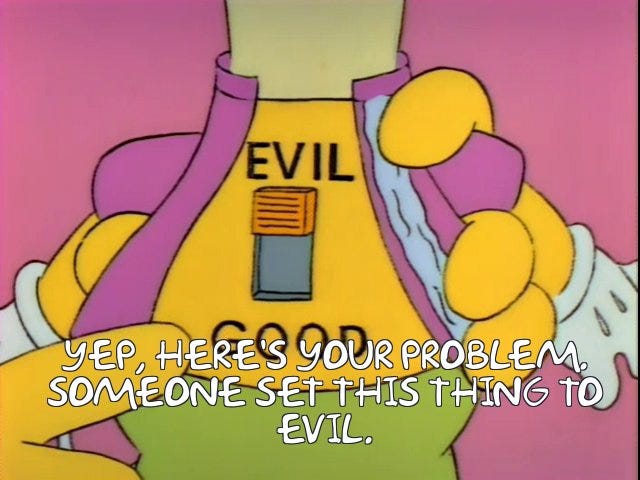
I have my reasons for feeling this way. Choosing to make The Media your career carries with it a precarity that I’ve experienced twice in the space of the last year, and not being in full-time employment for so long means I’ve had a lot of time to blame it all on myself, rather than the “attention economy” or generative AI or all of the more plausible reasons that the industry is currently a bad place to be in.
I made a scary but altogether positive decision last year to leave the country of my birth and, in effect, start again somewhere new. As someone who struggles to make new connections, that challenge began again, and there hasn’t been nearly as much progress as there could have been, eleven months in.
I think Stevens’ interview moved me so much because, while he grapples with the personal failure, he never loses sight of its meaning for others. There’s the view he has of himself and his misery, and the acknowledgement that he’s made something that will stay with people forever. “The album,” he says, “Is yours.”
When I die, will I be remembered for the time I spent doubting whether I even deserved to be in people’s lives? Or will those people remember kindnesses, favours given without anything expected in return, all the things that, at my lowest, I refuse to see myself as capable of?
What if we belong to other people as much or more as we belong to ourselves? What if our real secrets are not a palmful of baubles we keep inside some protected box, but the stories the loved ones who followed us with their eyes, who lavished their wondering love on us, told themselves?
Stevens’ words are like his music - poignant, gentle or terrifying at any one time. So, even if he can’t stand by his work, has he found solutions to his feelings elsewhere?
I find as I get older, experience makes fools of us all — I feel kind of stupider and less prepared for what life brings me in a lot of ways.
Stevens has lost both his father and his long-term partner in the time since Carrie & Lowell was released. He was also struck down with the autoimmune disease Guillain–Barré syndrome, and had to learn to walk again. Loss upon loss, heartbreak upon heartbreak.
He is able to find some resilience for the hardship he’s faced through his faith in God, something which has permeated his work from the beginning. He’s never wavered in that faith, but still finds himself searching for answers, which I think he finds in a way freeing.
Maybe truth is endurance, the substance of things that are eternal.
There’s a perseverance in all of Stevens’ work. Desperation and death is never far away, especially on Carrie & Lowell’s “Fourth of July”:

But the beauty of life in his work is never lost. In arguably his most popular song, “Chicago,” the narrator holds in one hand a kind of rapture, and in the other the freedom to keep going, all the same:
You came to take us
All things go, all things go…
It’s like Samuel Beckett’s “I can’t go on. I’ll go on.” There really isn’t anything for it, except to strike out again in whatever direction you can.
And this is one of his gifts to us. Sufjan I mean, not God. As much as a conversion to the Big Man’s way of things may reduce my self-loathing, I’ve got tattoos and I have coveted my neighbour’s ass so that door is probably closed to me.
I might not ever fully feel like I’m deserving of a place in anyone’s lives, except my own. This has been the reason for my general distancing from people - texts left unanswered for fear of saying the wrong thing, parties not attended. The idea of allowing myself to exist in the minds of other people without any say in it is miserable, paralysing. But is the alternative any better?
They gave perfect 10s to albums that are similarly perfect but made up of material from the previous century, including The Beach Boys’ The Smile Sessions, John Coltrane’s Olatunji Concert, and Pavement’s Quarantine the Past.